
A profession at a crossroads: The Ministry of Works, Housing & Water Resources, the Architects Registration Council (ARC), and the future of the architectural profession
08 October 2026
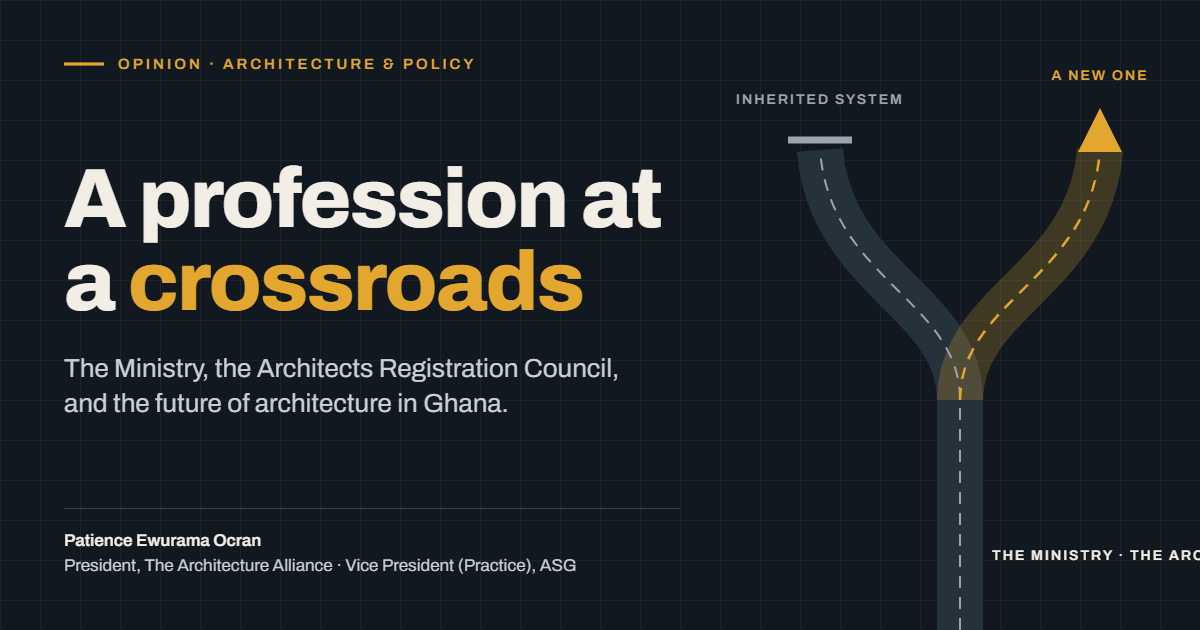
Is the Architects Registration Council a regulator or a gatekeeper? Patience Ewurama Ocran examines the 1969 Architects Act, the Ministry’s oversight role, and reforms that could shape architecture's future in Ghana.
The architectural profession occupies a unique position in Ghanaian society. It is simultaneously a profession, a public service, a business, a creative discipline and an important instrument of national development. The buildings, neighbourhoods, public institutions and urban spaces that shape our communities are all influenced directly or indirectly by decisions concerning land, planning, design, construction, regulation and investment; areas in which the architectural profession plays a significant role. Yet, despite this importance, the profession continues to face fundamental questions about its place in Ghana’s development and, more importantly, about the effectiveness of the institutions established to regulate and advance it. At the centre of this discussion are the Ministry of Works, Housing and Water Resources (MWHWR) and the Architects Registration Council (ARC). The question is not simply whether these institutions exist, but whether they are fulfilling the responsibilities for which they were established.
The ARC: regulator or gatekeeper?
Ghana’s architecture profession is protected by the Architects Act, 1969 (NLCD 357), which established the ARC and charged it with securing the highest practicable standards in the practice of architecture. Its statutory functions include professional education and examinations, maintaining the register of Architects, upholding professional conduct and ethics, and controlling the practice of architecture. However, concerns arise as to whether the Council is exercising the full breadth of this mandate or has, in practice, become primarily focused on registration and annual renewal. Effective regulation should extend beyond maintaining a register to safeguarding professional standards, protecting the public, addressing unlawful practice and ensuring that the profession evolves with the needs of society. This concern becomes more significant when one considers that the regulatory framework dates back to 1969. Architecture has since been transformed by technology, sustainability, digital practice, new construction methods, procurement systems and multidisciplinary professional services. Yet, architectural draughtsmanship and newer areas such as architectural technology and interior design remain outside a comprehensive regulatory framework.
The Ministry’s responsibility
The ARC does not operate in isolation. It falls within the broader institutional framework of the Ministry of Works, Housing and Water Resources. The Ministry’s responsibilities include policy formulation, sector coordination, monitoring and evaluation, regulation, capacity building, innovation, research and professional development. This creates an important oversight responsibility. The Ministry’s role should not merely be to accommodate the ARC within its administrative structure. It should also ensure that the Council has the institutional support, accountability mechanisms and capacity required to fulfil its statutory mandate. This does not mean interfering with the Council’s professional regulatory decisions. Rather, it means asking whether the regulatory institution itself is performing effectively and whether the legal and institutional framework remains fit for purpose. This question matters because architecture sits at the intersection of housing, land use, planning, construction, infrastructure, environmental sustainability, public procurement and urban development. The effectiveness of architectural regulation therefore has implications far beyond Architects themselves. What should change? Several reforms could strengthen the profession. These include: 1. Amendment of the Architects Act, 1969 to better protect the profession and reflect contemporary practice. 2. Strengthening of enforcement through better monitoring, investigation of complaints and unauthorised practice, and appropriate disciplinary action. 3. Ensuring that professional development is a more deliberate part of the regulation. Continuing professional development could address climate resilience, accessibility, building technology, sustainability, digital practice, contract administration and professional ethics. 4. Public education for the ordinary Ghanaian to understand what Architects do and why their services matter. 5. Ensuring that Architects have a stronger voice in national conversations concerning housing, urbanisation, climate adaptation, infrastructure, land development, public buildings and spatial planning. Architecture should be part of policy formation, not merely brought into the process after major decisions have already been made.
A profession at a crossroads
Ghana does not lack talented Architects or architectural schools. What is required is an institutional environment capable of converting that human capital into national value. The country needs regulators who regulate; It needs government agencies that recognise professional expertise; It needs laws that keep pace with professional reality; It needs enforcement that is fair and consistent; It needs professional bodies that advocate; and it needs Architects who are prepared to participate actively in shaping the future of their own profession. The ARC's mandate is to uphold the integrity of the architectural profession in Ghana. That mandate should not remain merely an institutional statement. It should become a measurable national project. This is because ultimately, the question is bigger than the ARC. It is bigger than the Ministry. It is even bigger than Architects. It is about what kind of Ghana we intend to build and whether the institutions responsible for the built environment are prepared to build the systems that can make that Ghana possible. The Ministry and the ARC therefore stand at a crossroads with the future of the profession. They can remain administrators of an inherited system. Or they can become Architects of a new one. The future of architecture in Ghana depends less on whether these institutions exist, and more on whether they have the courage to evolve.
← Back to news